lunes, 11 de octubre de 2010

Bunker-42 en Taganka / Bunker-42 in Taganka


El Museo de la Guerra Fría (exposición compleja Bunker-42) es un museo militar histórico y un complejo de entretenimiento fundada en la antigua URSS objeto clasificado militar - Suplente Centro de Comando de Aviación de Largo Alcance (IR-42). El territorio del museo representa un búnker subterráneo con un área de 7000 m2 situado a 60 m de profundidad cerca de la estación de metro Taganskaya. El museo esta abirto desde 2006, después de Bunker-42 fue comprado de "Rosimuschestvo" en la subasta por "Novik Servicio" de la compañía.
La construcción comenzó en 1951 debido a la amenaza de la guerra nuclear en los EE.UU.. Para la construcción se utilizó el mismo equipo como para la construcción del metro. Los túneles del complejo está conectado con el metro de Moscú.
En la década de 1960 estaba equipado con todo lo necesario en el caso de un ataque nuclear. Más tarde, en medio de los años 70, se tomo una decisión sobre su reconstrucción. En 1995 fue desclasificado por completo. En el año 2006 "Novik-service" fue comprado por 2.166.700 dólares y comenzó su restauración con puertas blindadas y el acero de revestimiento de las paredes.

English Version

The Cold War Museum (exhibition complex Bunker-42) is a military historical museum and an entertaining complex founded in the former classified military object of the USSR - Alternate Command Center of Long-Range Aviation (GO-42). The territory of the museum represents an underground bunker with an area 7000 m2 located 60 m deep near Taganskaya metro station. The museum has been working since 2006 after Bunker-42 was bought from “Rosimuschestvo” at the auction by “Novik Service” company.
Construction of the object began in 1951 due to the threat of the nuclear war in the USA. For the construction there was used the same equipment as for the construction of the metro. The tunnels of the complex are connected with the Moscow metro.
In the 1960s the object was equipped with everything necessary in the case of nuclear attack. Later, in the middle of the 70s, there was made up a decision about its reconstruction. In 1995 the object was totally declassified. In 2006 “Novik-Service” purchased the object for 2,166,700 USD and started its restoration. Only massive armoured doors and steel sheathing of the walls remind about the former classified object.

viernes, 8 de octubre de 2010

Siberia a principios del siglo XX - Siberia in the Early 20-th Century


En 1904 joven pintor Boris Smirnov fue enviado por el transporte de prisioneros a Siberia, y su camino fue a lo largo de la Gran Siberia. En su camino se fue haciendo bocetos de los colonos y habitantes de esta lejana región, así como de su forma de vida y el paisaje de Siberia y, finalmente, haciendo cola toda una serie de dibujos y acuarelas.

English Version

Back in 1904 young painter Boris Smirnov was sent by prisoner transport to Siberia; and his path went along the Great Siberian Tract. On his way he was making sketches of settlers and locals of this distant region, as well as of their way of life and Siberian landscape and eventually lining up a whole series of drawings and water-colour paintings.

jueves, 7 de octubre de 2010

Ejército de Estonia / Army of Estonia


Secretos ocultos en la Universidad estatal de Moscú / Secrets Hidden Under The Moscow State University


Este es el del edificio de la Universidad Estatal de Moscú - para algunas personas supongo, que es el lugar desde donde se puede entrar en el secreto "Metro 2", otros creen que es un lugar perfecto para una granja de ratas de prueba ...
Por supuesto, este acceso esta denegado para los estudiantes. Pero si sabes dónde ir, qué puertas para romper, y dónde esconderse de la seguridad con perros hambrientos, que con confianza puedes descubrirlo.
Usted puede encontrar una colección de minerales en esta sala.
Otra leyenda - crysystems que congela temporalmente el suelo debajo del edificio. Si alguien los pone en marcha, el edificio puede caerse en el río Moskva y una creciente ola se lleva el monumento de Pedro el Grande por Tsereteli.
En 1990 las habitaciones se inundaron y aquí llegó la humeda y la corrosión, productos químicos disueltos en el agua ...

English Version

Basement of the Moscow State University building - some people suppose it’s the place from where one can enter the secret “Metro 2″, others believe it to be a perfect place for a test rats farm…
Of course for ordinary curious students access to the basement is denied. But if you know where to go, what doors to break, what cam to smile at and where to hide from the security with hungry dogs, you may confidently start out.
You may find a collection of minerals in this room.
Another legend - crysystems that are temporarily freezing the soil under the building. If someone turns them on, the building may fall in the Moskva river and a rising wave will wash off the monument to Peter the Great by Tsereteli.
In 1990s the rooms were flooded and here settled dampness, insanitariness and corrosion, chemicals dissolved in the water…

martes, 5 de octubre de 2010

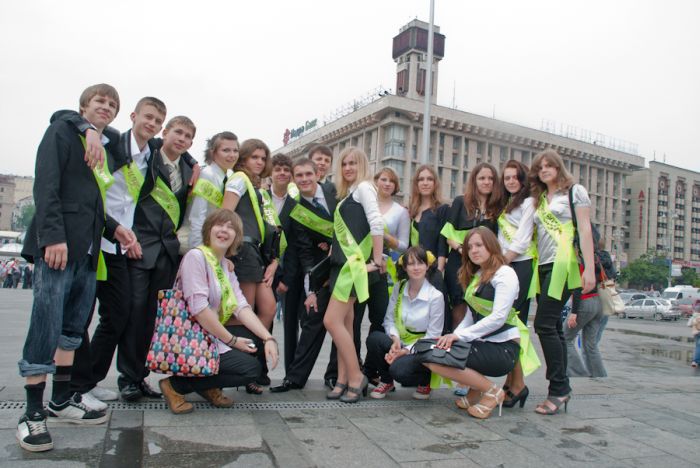
Graduados 2010 en Kiev - Kiev School Graduates 2010


Básicamente, los rituales de la escuela de graduados de Rusia no es diferente de la misma de los ucranianos, el hecho de que todo era parte de un gran país, la Unión Soviética.
Así que si usted visita las fotos de Kiev ahora usted puede ver que hay cosas casi igual.

English Version

Basically, the rituals of Russian school graduates no different from the same of the Ukrainian ones, just because it’s all was a part of one big country, the Soviet Union.
So if you check those photos from Kiev now you can see there almost same stuff